Our vision for music in Moreton Morrell is to provide every child with a solid foundation in musical skills. We seek to build every child’s love of music through high quality musical experiences, both within and outside of school. Learning music develops all aspects of a child’s learning from the physical action of using an instrument to the mathematical skills needed to keep a pulse. At Moreton Morrell we provide every child with high quality music lessons, enrichment activities and opportunities outside school. Pupils are taught by a specialist music teacher, developing skills in composing, performing, listening to and appraising music. We aim for every child to leave Moreton Morrell with an understanding and love of music which they can carry with them for the rest of their lives
Moreton Morrell School has a strong reputation for music. Pupils use a range of real and digital instruments (via ICT) to compose and perform. All pupils learn to play the recorder and glockenspiel in KS1 and the ukulele in KS2. We have a strong culture of singing in worship, which is reinforced through our school choir which rehearses weekly. All children participate in performances with an emphasis on music and singing, and an annual concert is held to share our pupils’ musical talents. Children are given the opportunity to perform weekly in our Respect Assembly.
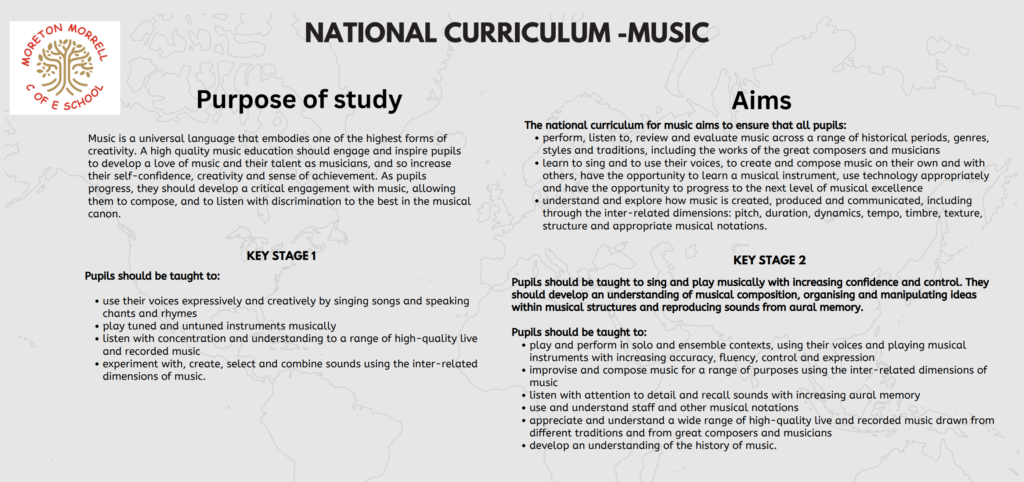
The music curriculum is designed to build a musical foundation and build on skills and knowledge throughout the years. Pupils will become confident in their ability to create, compose, perform and listen. Children will leave KS1 with good understanding of a variety of rhythms and pitches and basic knowledge of stick notation, using crotchets, quavers and rests. They have learnt and practised key glockenspiel skills through taught exercises and composition activities. As students progress through KS2 they become more confident in their singing and musical skills on a variety of tuned and untuned percussion instruments. Students have a more in depth understanding of the inter-related dimensions of music and can describe music using key terms (pitch, pulse, rhythm, tempo, dynamics). They have an increased awareness of different genres of music and music from other countries and can improvise and create music in different styles and metres, including compound time. Pupils can read and transcribe stave notation using simple and compound time, complex rhythms, including dotted rhythms, and pentatonic scale. We aim for pupils to move onto KS3 with a passion to learn and share their love of music.
Teaching Music in Early Years to ensure a strong foundation
In Preschool and Reception, children begin to experience making music together in their weekly curricular music lessons. Through singing games, songs, rhymes and listening activities, children learn to recognise and recall songs, pitch match and begin solo and small group singing. EYFS children begin learning ensemble skills with glockenspiel and other percussion instruments.