
Teaching Geography in Early Years to ensure a strong foundation
In Early Years, understanding the world through Geography is an important part of our curriculum. ‘Understanding the World’ encompasses a range of early geographical skills and knowledge in Early Years. Our focus for teaching and learning is on hands-on experience and developing the language and communication skills that will enable children to make comparisons, ask questions and make connections in their experiences. The children’s developing understanding of place and community is like an ever-widening circle. We start by talking with the children about their homes, the people who live with them and the people who are important to them. We also talk about what makes them the same or different to other children. The children start to become aware of the local landmarks that are significant to them and we incorporate photographs of these into a small world and block play. We talk about the village of Moreton Morrell and beyond to develop the children’s understanding of place through talking about where we live, local landmarks and where other significant people in individual children’s lives live. The children are encouraged to think and talk about their impact on the world around them and take part in a litter pick organising the collection into recyclable and non recyclable materials. Alongside planned learning, children are encouraged to follow their own interests and create ideas around their own fascinations.
How we teach Geography
As outlined above, our geography curriculum begins in EYFS with the people, culture, communities strand of understanding the world. We begin with what children know so that they can start by sequencing their own lives, photos and objects they use. The curriculum is then carefully sequenced across Key stage 1 and 2, so that children revisit and build upon these early learning experiences.
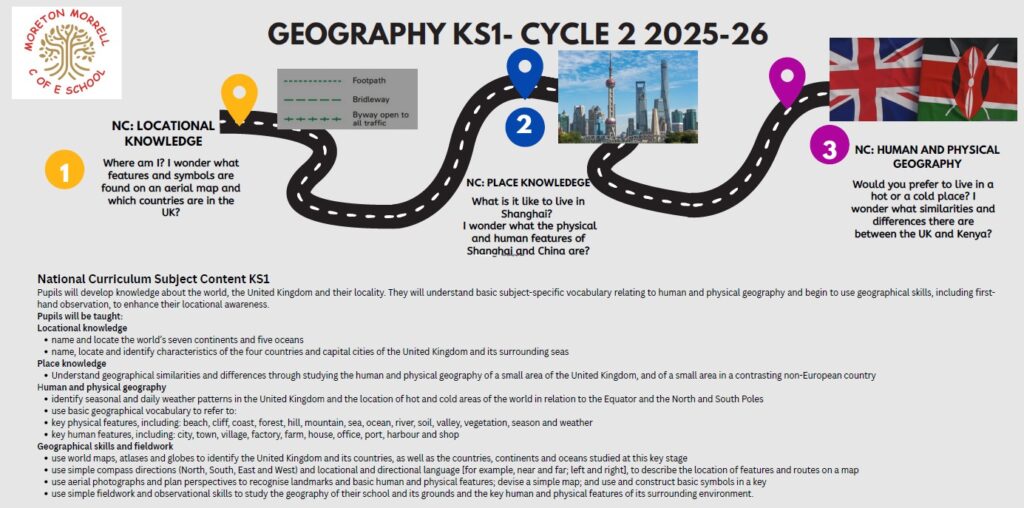
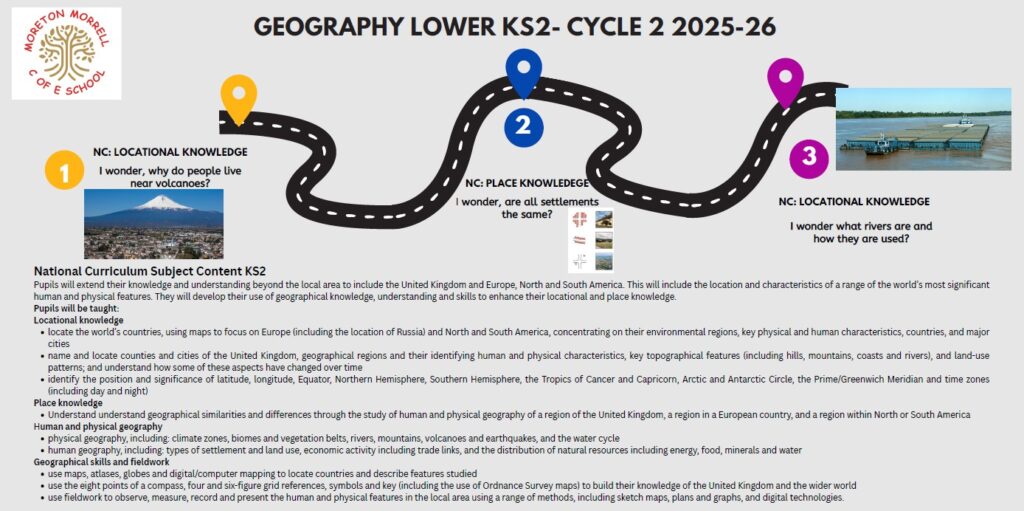
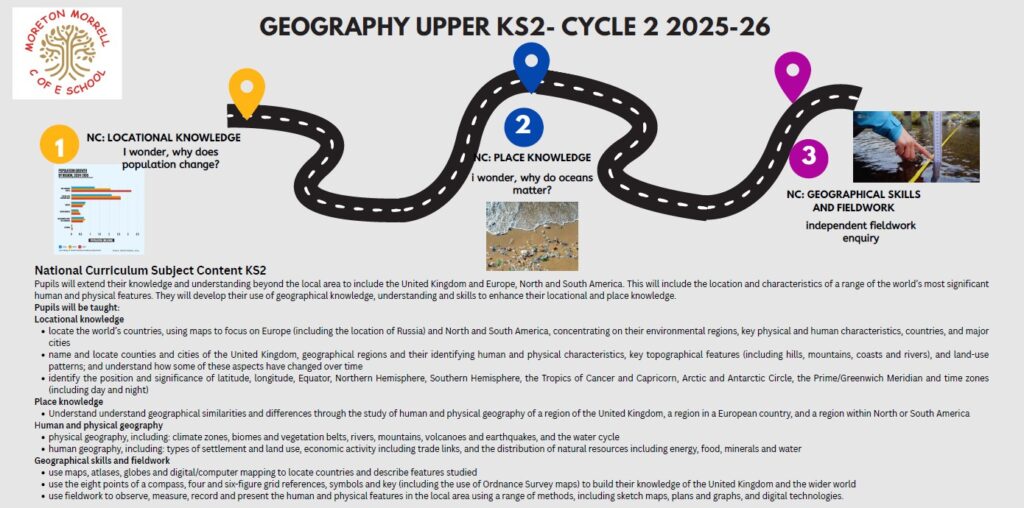
Children in Key Stage 1 and 2 learn about the main concepts outlined in the National Curriculum. These are organised in such a way as to maximise the opportunities to make links across units, continually making comparisons between places studied. Pupils learn about countries whose human and physical features they can compare. Whilst also exploring and learning about the geography of our local area to provide a known comparison point. We use our local area whenever possible to ensure that understanding is routed in the local context ensuring that pupils have firm foundations for their learning.
Each unit has a comprehensive planning document which provides teachers with a knowledge organiser, carefully tiered vocabulary, a suggested teaching sequence and a wide range of high-quality suggested activities which can be used to support the learning within the unit.
.
